

Strategies and Tools for Real Time EArthquake RisK ReducTion
Programme: FP7 – Cooperation: Environment (including Climate Change)
Grant Agreement: 282862
Duration: 1 September 2011 – 31 December 2014
Coordinator: AMRA – Analisi e Monitoraggio del Rischio Ambientale S.c.a.r.l., Italy
Total cost: €10.11 million
EU contribution: €6.97 million
REAKT was developed to improve the effectiveness and reliability of real-time earthquake risk reduction, with particular attention to the protection of people, buildings, critical infrastructure and essential services.
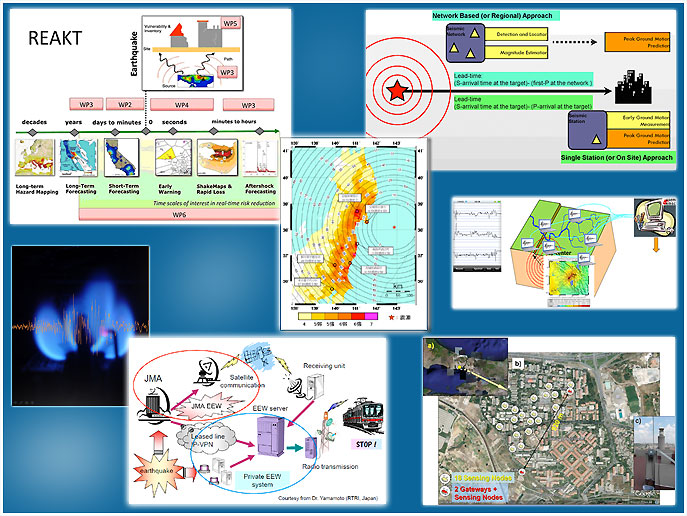
The project brought together earthquake forecasting, early warning, rapid damage assessment and real-time vulnerability analysis within a common probabilistic framework. A central objective was to ensure that uncertainty was explicitly considered throughout the decision-making chain, allowing scientific information to be used more effectively in operational contexts.
Its work addressed:
Operational Earthquake Forecasting
Earthquake Early Warning
Rapid Damage And Loss Assessment
Real-Time And Time-Dependent Vulnerability
Probabilistic Risk Assessment
Uncertainty Quantification
Decision-Making Under Uncertainty
Capacity Building And End-User Engagement
REAKT adopted a strongly multidisciplinary approach, combining seismology, structural and geotechnical engineering, statistics, sociology and governance. The project was organised around seven scientific work packages covering the full chain from earthquake-generation processes and short-term seismic changes to operational forecasting, early warning, vulnerability assessment and decision support.
A particularly important feature of the project was its emphasis on real-world applications and end-user needs. REAKT tested and demonstrated its methods across strategic infrastructures and services, including nuclear, hydroelectric and coal power plants, bridges, electricity and gas networks, oil refineries, ports, railways, schools and hospitals.
This operational perspective allowed the project not only to test scientific and technological developments, but also to identify the scientific, regulatory and organisational factors that can facilitate or hinder the adoption of earthquake early-warning and short-term forecasting systems.
The project involved 23 organisations from 10 European countries as well as partners from Japan, Taiwan, the United States, Barbados and Trinidad and Tobago, bringing together universities, research institutes and professional organisations.
Key themes: Earthquake Risk Reduction · Earthquake Early Warning · Operational Earthquake Forecasting · Real-time Vulnerability · Probabilistic Risk Assessment · Critical Infrastructure · Decision Support · Uncertainty · Preparedness · Risk Governance